
Craft · Bidar · Karnataka
Bidriware
Metal inlay from Bidar. Silver set into a blackened alloy ground, where the darkening is what makes the pattern read.
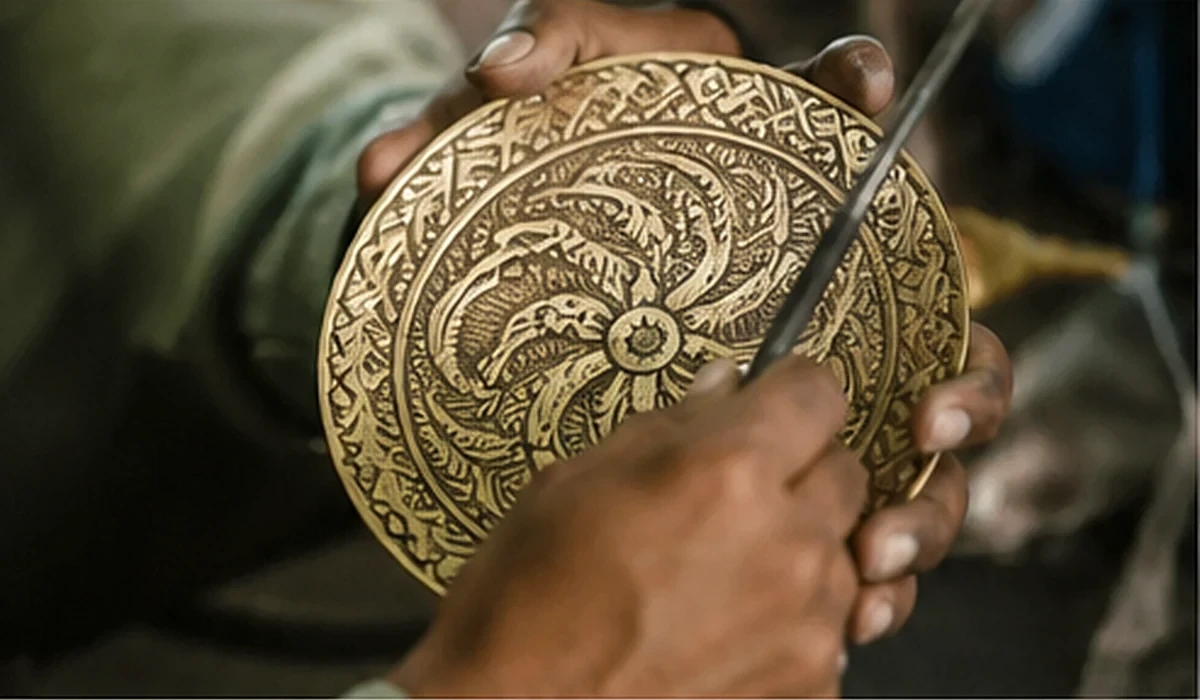
Bidar · Karnataka
Look for crisp inlay, smooth finishing, proportion and the visual tension between dark ground and bright metal pattern.
Making process
Technique leaves evidence.
The smith casts and finishes the object, engraves the design, and sets silver into the cut. Darkening the ground last is what makes the pattern step forward.
We name a maker only when we can prove it. Where a piece carries a maker’s name, that name has been verified.
The pattern only appears at the end, when the ground is deliberately turned black.
Where it comes from
Bidar in northern Karnataka, which gives the craft its name. The work is concentrated in a small number of workshops in and around the town and carries a Geographical Indication.
How the tradition developed
The craft developed under the Bahmani and Bidar sultanates, and its ornament shows the same Persian influence found in the region's architecture — arabesque, vine, poppy, geometric lattice. It has remained a specialist metalworking tradition rather than a domestic one, passed within workshops.
How it is made
The smith casts the object in an alloy of zinc with a small proportion of copper, then files and blackens the surface temporarily so the design can be seen while it is engraved. The pattern is cut into the metal, and pure silver — as fine wire for linear work, as sheet for broader shapes — is hammered into the cut and dressed flush. The finished piece is then treated with a paste made using soil from within Bidar fort, which turns the alloy a deep permanent black while leaving the silver bright. That final blackening is what makes the pattern legible.
What it is made of
Zinc-copper alloy body, pure silver inlay, and the local soil used for the oxidising treatment.
What to look at
Run a finger across the inlay: it should be flush with the surface, not proud of it or sunk below. Look for crisp edges where silver meets black, and consistent depth of black across the whole ground.
Living with it
Keep dry. Wipe with a soft dry cloth. Do not use silver polish or abrasives — polish attacks the black ground, which is the point of the object.
For gifting at volume
Strong for executive desk pieces and senior recognition gifts. Small items work at moderate volume; larger vessels are slow and better suited to individual presentation.
Craft-level description compiled by TGA. We describe traditions and techniques here, not individual makers — a maker is named only where we have verified them.