
Craft · Central India · Madhya Pradesh
Gond Visual Art
A visual tradition from Gond communities. Line and dot fill every form until animals, trees and figures carry their own rhythm.
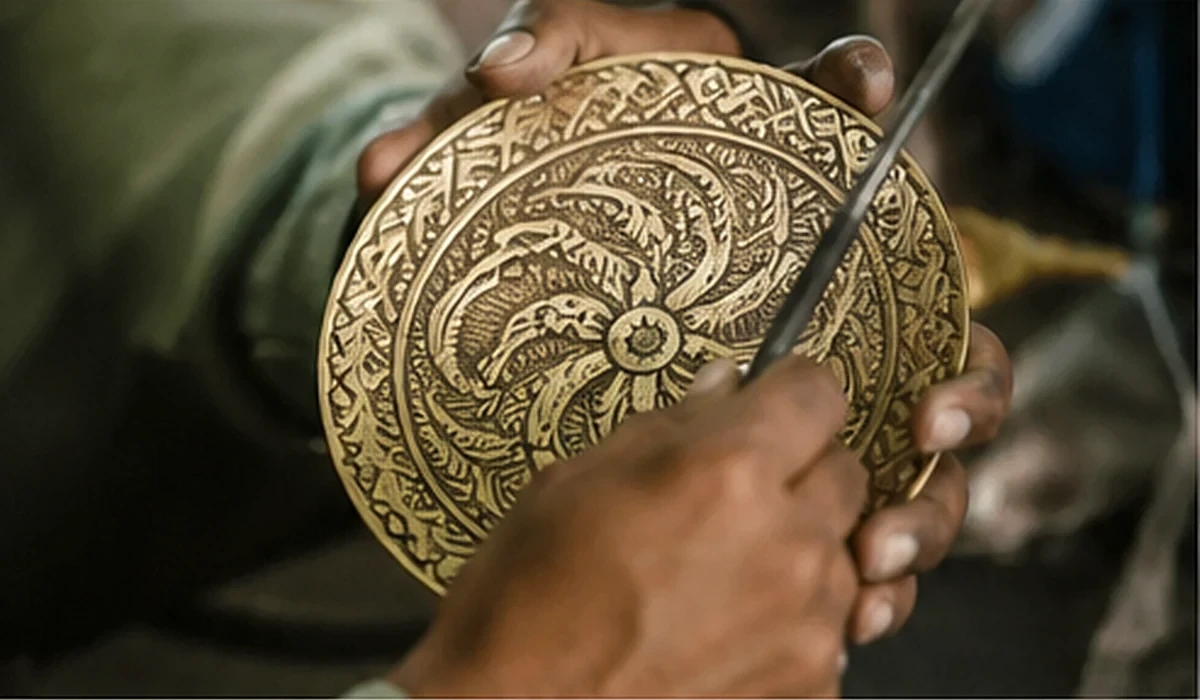
Central India · Madhya Pradesh
Look for the internal patterning that gives animals, trees and figures their visual rhythm and movement.
Making process
Technique leaves evidence.
The artist draws the form first, then fills it — line upon line, mark upon mark — until the pattern inside the animal begins to move.
We name a maker only when we can prove it. Where a piece carries a maker’s name, that name has been verified.
Line and dot fill every form until the animal begins to move.
Where it comes from
The Pardhan Gond community of central India, principally in Madhya Pradesh. What is now made on paper and canvas grew directly out of a tradition of painting on the walls and floors of homes.
How the tradition developed
The move onto portable surfaces is recent and well documented: from the early 1980s, artists of the community began working on paper and board and the form found a wider audience. It is one of the few Indian folk traditions with a clear, traceable modern history and a body of named contemporary artists — which is precisely why attribution should be handled carefully rather than generically.
How it is made
The artist sets down the outline first, usually an animal, a tree or a figure drawn from the community's stories. The interior is then filled with a repeated signature mark — dots, dashes, commas, fine parallel lines — applied patiently until the whole surface is worked. That fill is not decoration added afterwards; it is what gives the form its movement, and individual artists are recognisable by their particular mark.
What it is made of
Traditionally earth and plant pigment on prepared wall surfaces; now more often acrylic on paper or canvas.
What to look at
The quality of the fill is the thing to judge. Marks should be even in pressure and spacing without becoming mechanical. Look at where the fill meets the outline, and at how the pattern turns a corner.
Living with it
Frame behind glass, away from direct sunlight. Works on paper are sensitive to humidity.
For gifting at volume
Effective as framed gifts for senior recipients and as artwork for offices. Where a work is by an identifiable artist, that artist should be named and paid accordingly, not treated as anonymous craft.
Craft-level description compiled by TGA. We describe traditions and techniques here, not individual makers — a maker is named only where we have verified them.